A publication of the Archaeological Institute of America

| |
| China's Sleeping Beauty | April 10, 2009 |
| by Eti Bonn-Muller | |
A landmark exhibition awakens the legacy of a Western Han Dynasty noblewoman
![[image]](thumbnails/mawangdui1.gif)
|
This wax model depicts how a Chinese noblewoman known as "Lady Dai," who lived some 2,200 years ago, looked at age 30. Zhao Chengwen, a professor at the China Criminal Police College, developed the technology—known as the "Jingxing CCK-3 Model Human Face Mirage System"—used to create the reconstruction. (Courtesy of Hunan Provincial Museum) |
The early 1970s excavation of three Western Han Dynasty (206 B.C.-A.D. 8) tombs at Mawangdui, in China's southern Hunan Province, yielded some the country's greatest archaeological discoveries ("Entombed in Style," May/June 2009). The family members buried there included Li Cang, the marquis of Dai; his wife, Xin Zhui, known today as "Lady Dai"; and a man in his 30s, thought to be either the couple's son or Li's brother. The rich and powerful family led a luxurious life, which they wanted to maintain in the afterlife. The burials, therefore, contained a wealth of exquisite items, such as lacquerware, embroidered silk, musical instruments, and depictions of the household's servants--more than 3,000 objects in all.
A selection of some 70 unforgettable finds from the famous site are now on view at the China Institute Gallery in New York City in the landmark exhibition, Noble Tombs at Mawangdui: Art and Life in the Changsha Kingdom, Third Century BCE to First Century CE. This is the first show in the United States ever to focus exclusively on Mawangdui. (The show will be at the Santa Barbara Museum of Art from September 19 to December 13.)
Presented here is a selection of excavation images, as well as finds from the burials that are in the exhibition. Lady Dai's tomb was unquestionably the most impressive of the three. Not only was it intact, but her body, discovered in the innermost of four nested lacquer coffins, was so well preserved that medical experts were able to perform a full checkup, gynecological examination, and autopsy.
Willow Weilan Hai Chang, director of the China Institute Gallery, is the project director who organized the Noble Tombs exhibition. In an interview with ARCHAEOLOGY ("Digging Up China's Best Exhibitions"), she discusses her own memories of excavating along the Yangtze River and how they inspire her work today.
![[image]](thumbnails/mawangdui4.gif) |
![[image]](thumbnails/mawangdui5.gif) |
| On December 14, 1972, surgeons from the Hunan Provincial Medical Institute performed an autopsy on Lady Dai's still-moist remains. Dr. Cao Meihong worked on her head; Dr. Peng Longxiang on her body. This photo (left) was taken before the procedures, as she was receiving antiseptic treatment. (Although no embalming solutions were found in her body, a translucent fluid that quickly browned surrounded her remains in her coffin. The archaeologists who first examined her reportedly suffered from a rash on their hands for months.) In 2003, an expert from Xiang Ya Medical School of Zhong Nan University examined Lady Dai before moving her to a new display case (right). Over the years, her intact veins have been repeatedly injected with a "secret" preservative solution. (Courtesy of Hunan Provincial Museum) | |
| Photo Galleries | ||
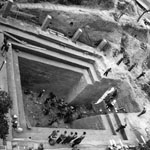
The Excavation of Lady Dai's Tomb |
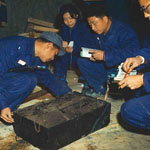
The Third Tomb at Mawangdui |
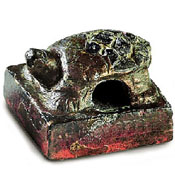
A Selection of Artifacts from Mawangdui |
Eti Bonn-Muller is managing editor at ARCHAEOLOGY.

© 2009 by the Archaeological Institute of America
archive.archaeology.org/online/features/mawangdui/
Advertisement

Advertisement