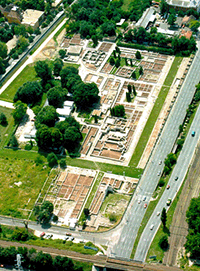
(Courtesy Aquincum Museum)
Roman ruins might not be what
tourists expect to see in Budapest,
Hungary, famous for its medieval
architecture and atmosphere. The
Romans arrived at the stretch of the
Danube that divides Buda from Pest
in the first century A.D. and founded
the town of Aquincum. The town and
river served as defenses against the
tribes beyond. In A.D. 106, the town
became the capital of Lower
Pannonia under the rule of Trajan,
and consisted of a fortress, a
military town, and a civil town a few
miles north. At its peak, Aquincum
had more than 50,000 inhabitants,
making it one of the largest towns
on the Roman frontier. By the end of
the third century A.D., under
constant attack from across the
river, the civil town was abandoned.
The fortress and military town
survived until the fifth century A.D.
According to Orsolya Láng,
archaeologist and deputy head of
the Aquincum Museum, the civil
town site, in particular, is a rarity
because, unlike many Roman sites, it
was never built over.
The site
The fortress and military town of
Aquincum became the center of
the medieval city of Buda, and were
built upon many times, wiping out
most Roman remains. The civil town,
however, lay untouched
for centuries. Today the
civil town is one of the
largest preserved Roman
towns in Central Europe,
but many visitors to
Budapest never see the
ruins, perhaps because
they are a three-mile
train ride from the city
center. While many of
the buildings fell victim
to medieval stone
quarrying, some ruins
have remained visible
on the surface, and excavations that
started in the late nineteenth century
uncovered more.
The civil town grew quickly at the
beginning of the second century,
with the construction of public
and private baths, aqueducts, an
amphitheater, a street system, and
town walls. The eastern part of the
ancient town is open to the public,
including the forum complex, a
great bath with a well-preserved
floor-heating system, a sanctuary
dedicated to Fortuna Augusta, a row
of shops, and the market building.
Behind these public structures are
the remains of the homes of town
magistrates, decorated with wall
paintings and even mosaics. New
attractions have recently been
introduced in the archaeological
park, including a
model of a Roman
house to replace one
that was destroyed
during World War II.
There are also three
"chronoscopes,"
which allow visitors
to see the ruins as
they used to appear,
a Roman-themed
playground for
children, and a room
with computer games
where visitors can
virtually fight as gladiators.
While you're there
After a tour through the ruins, which
should take one to three hours, be
sure to visit Nagyi palacsintázója, or
"Granny's Pancake Bar," a popular
crepe restaurant nearby. There is
much to see in Budapest, including
the famous Buda Castle and its
surrounding district, full of great
views, narrow streets, and medieval
and Baroque architecture. The
city also has dozens of museums,
including the Hungarian National
Museum, Museum of Fine Arts, and
several historical museums such as
the Terror Museum, dedicated to
the history and brutality of Nazi and
Communist occupation.