Hundreds of metal artifacts pinpoint the possible site of a bloody battle
between conquistadores and a Puebloan people
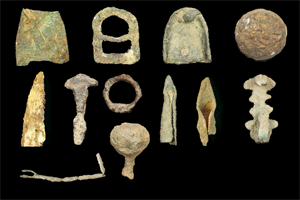
A rich assembly of metal artifacts from the site of Piedras
Marcadas in New Mexico reveals the location of a violent
episode during Francisco Coronado's expedition.
Top row: piece of copper armor, belt or strap loop, the
tip of a belt or scabbard, piece of lead shot
Middle row: broken dagger tip, "caret head" nail, chainmail
link, two crossbow bolt heads, ornate belt loop
Bottom row: needle, lead button.
(Courtesy Matt Schmader)
In a dirt lot five miles from downtown Albuquerque,
Matthew Schmader, the city's archaeologist,
kneels to examine a sharp flake of obsidian. "This
could have been from a weapon one of the native
troops brought up from Mexico," he says, referring
to the sixteenth-century Spanish expedition led by
Francisco Vázquez de Coronado. Cars hum past on Coors
Boulevard, and a breeze ripples cottonwood leaves along the
Rio Grande River, half a mile east. If the weather is good,
and sometimes even if it's not, chances are Schmader will
be hard at work in this city-owned property surrounded by
housing developments.
A rich assembly of metal artifacts from the site of Piedras
Marcadas in New Mexico reveals the location of a violent
episode during Francisco Coronado's expedition.
Top row: piece of copper armor, belt or strap loop, the
tip of a belt or scabbard, piece of lead shot
Middle row: broken dagger tip, "caret head" nail, chainmail
link, two crossbow bolt heads, ornate belt loop
Bottom row: needle, lead button.
"The site is pretty much the most important thing that has
happened in the past 20 years relative to our understanding of
Coronado," Schmader says. The ground is littered with pottery
fragments and hundreds of red marker tags staked in the dirt.
Each tag represents a metal artifact—the tip of a crossbow bolt, a
broken buckle—from Coronado's 1540 to 1542 expedition. The
first major organized expedition into what is now the southwest
United States, it ended in fighting and failure, setting an ominous
example for future relations with the region's native inhabitants.
Schmader stands up, brushes his knees and smiles. "It never
fails to amaze me every time I'm here," he says. "I feel like I
was handed a gift from the archaeology gods."

To read more, find ARCHAEOLOGY in your local newsstand or bookstore, or click here to buy a copy of the issue online. And if you'd like to receive ARCHAEOLOGY in your mailbox, click here to subscribe.
Julian Smith is a contributing editor at ARCHAEOLOGY.