Evidence from both excavations and rare manuscripts reveal much about early Ireland's cosmology and its people's deep connection to the land
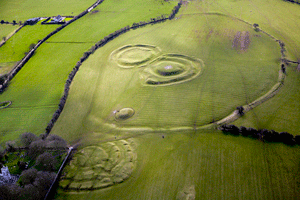
An aerial view of the royal site of Tara (looking southeast). Referred to in medieval manuscripts, its largest enclosure, Fort of Kings, encircles three others: A possible ring barrow (left) called King's Seat sits alongside a ring fort (right) called Cormac's House, and the small mound (below them) is a passage tumulus called Mound of the Hostages. A later churchyard wall (bottom) borders an early double enclosure known as Ráth of the Synods.
(©John Herriott)
Tara near the midpoint of the north-south line connecting Emain Macha and Dún Ailinne. The significance of this arrangement is still unknown, but it is notable. Archaeological work shows that early activity at these sites may have had to do with burials, and that these enclosures were constructed during the Iron Age. Surprisingly, none of them are suitable for defense. Instead, each seems to mark off an area that only makes sense if viewed as sacred.
One of the compelling things about doing archaeological work in Ireland is that the early medieval manuscripts preserve so many tales surrounding these sites. Some stories are clearly mythological, others are pseudohistory—medieval invention—and it isn't always easy to tell them apart. Even so, they are essential in developing a full understanding of the sites. And, in turn, by studying the sites archaeologically, we can begin to understand some of the meaning behind the myths. Collections of Old and Middle Irish stories called dindshenchas, literally "histories of places," were compiled between the tenth and twelfth centuries A.D. and imply a sacred geography for the pre-Christian sites in Ireland. All the places listed in these stories are connected with the old gods.

To read more, find ARCHAEOLOGY in your local newsstand or bookstore, or click here to buy a copy of the issue online. And if you'd like to receive ARCHAEOLOGY in your mailbox, click here to subscribe.
Ronald Hicks is a professor of anthropology at Ball State University specializing in landscape and cognitive archaeology.